
Mangaiti Playground Hamilton – Curved Turf Surfaces
Mangaiti Playground in Hamilton demonstrates how playground turf can be integrated as a thoughtful, design-led surface within a public landscape. Rather than treating the surface as purely functional infrastructure, this project showcases playground turf as an active design element that shapes movement, defines space, and enhances the play experience.
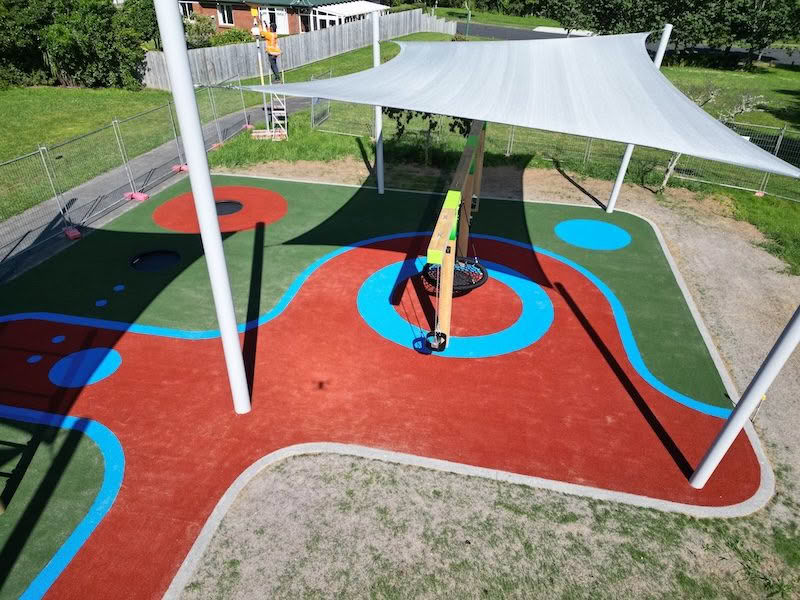
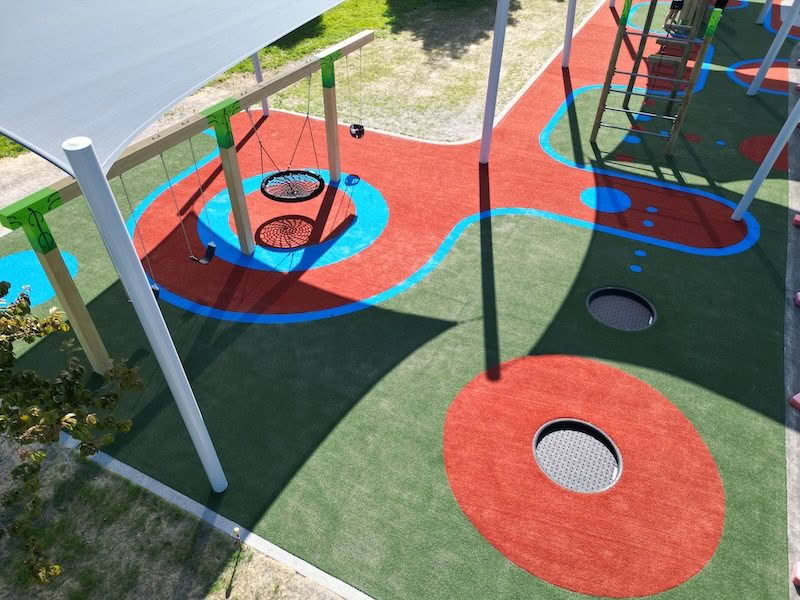
The playground’s flowing curves, arcs, and subtle circular inlays support movement, spatial definition, and playful exploration, while maintaining a cohesive visual language across the site. This landscape-led playground design approach positions the synthetic playground surface as integral to both aesthetic quality and play functionality.
Design-Driven Colour Palette for Spatial Zoning
A restrained palette of CoolPlay Baby Blue, Gravel, and Green was chosen to articulate zones and pathways within the playground turf system, balancing playful visual cues with a naturalistic aesthetic that sits comfortably within Hamilton’s park context.
The colours guide activity and movement through the space, creating intuitive wayfinding for children while complementing the surrounding park environment. For landscape architects, this demonstrates how synthetic playground surface colour selection can function as both a design tool and a behavioural cue, supporting active play patterns without relying solely on equipment placement.
The subtle tonal shifts between zones allow the surface to recede visually when appropriate, ensuring the playground feels integrated rather than imposed within the wider landscape setting, a key consideration in landscape-led playground design.
Curves, Arcs, and Precision Geometric Detailing
The playground turf surface features carefully measured curves and arcs, along with small circular inlays, demonstrating how synthetic turf can be manipulated to support formal and playful geometry simultaneously. These curved forms create dynamic movement paths, encourage circular play patterns, and provide visual rhythm across the site.
Precision installation was essential to achieving seamless joins and accurate shaping, reflecting the landscape-led playground design intent. Unlike traditional rectangular or linear turf layouts, the curved geometry required:
- Detailed setting out
- Skilled joining of curved seams
- Accurate installation of circular inlays
- Coordination between base preparation and final surface geometry
This level of detailing allows the playground turf to function as a designed landscape element rather than a generic safety surface, giving landscape architects greater control over spatial quality and user experience.
Safety and Sustainability Through Layered Construction
Beneath the visible synthetic playground surface, a recycled shock pad was installed to provide compliant impact protection across the play area. This underlay delivers critical fall-height requirements while aligning with sustainable design principles, an increasingly important specification consideration for public projects.
A professionally prepared base ensures long-term durability, accurate surface levels, and effective drainage, protecting the design investment over time. The layered construction includes:
- Compacted aggregate base for stability and drainage
- Recycled shock pad for impact attenuation
- Premium playground turf surface for durability and aesthetics
From a landscape architect’s perspective, this systems-based approach ensures the surface performs reliably across multiple criteria: safety compliance, environmental responsibility, maintenance efficiency, and design longevity.
Professional Installation as a Design Tool
Mangaiti Playground illustrates how playground turf in Hamilton can function as both a safe play surface and an integrated landscape element when specified and installed to design-quality standards. Through careful colour selection, geometric detailing, and high-quality installation, the synthetic playground surface contributes to a refined, flexible, and enduring public space.
For landscape architects working on landscape-led playground design projects, this installation demonstrates the material’s capacity to:
- Support complex geometries and custom shaping
- Integrate seamlessly with wider landscape narratives
- Deliver safety compliance without compromising design quality
- Provide long-term performance in high-use public environments
The result is a playground surface that enhances rather than compromises the landscape design intent, a critical consideration when playground turf is specified within considered public realm projects.
Specifying Playground Turf for Design-Quality Outcomes
When specifying playground turf for landscape projects, designers should consider:
- Colour palette coordination with existing landscape materials and planting
- Geometric complexity and installer capability for curved or detailed layouts
- Shock pad integration for safety compliance and sustainability objectives
- Base preparation standards to ensure long-term surface stability
- Installation quality as a critical factor in achieving design intent
Mangaiti Playground demonstrates that with careful specification and skilled installation, synthetic playground surface systems can deliver design-quality outcomes that support both play functionality and landscape character.